


Rethinking our response to gender-based violence: An International Women's Day speech, 2026
Alina Thomas, CEO, presented this speech to the staff of Home Base Hobart as part of International Women’s Day 2026.
Together we discussed the challenges young women face in Tasmania and the practical ways organisations and communities can strengthen support, build resilience, and create opportunities for safety, belonging, and growth.
Meaningful change grows when organisations connect, share knowledge, and work side by side for the future of young Tasmanians.
Change grows when we work together.
Media Release - Call for Tasmania to transform the systems that condone and enable violence - No to Violence National Conference, Hobart
MEDIA RELEASE
11 March 2026
CALL FOR TASMANIA TO TRANSFORM THE SYSTEMS THAT CONDONE AND ENABLE VIOLENCE – NO TO VIOLENCE NATIONAL CONFERENCE, HOBART
CEO, Alina Thomas will lay down the gauntlet tomorrow to Tasmanian institutions saying systems are built on social norms that privilege male dominance and female compliance.
Speaking tomorrow at the 2026 National Conference: Ending Men’s Family Violence: From local practice to national strategy, the CEO of Tasmania’s specialist family violence organisation, Engender Equality said,
“If we are serious about addressing gender-based violence, we must examine the actions of individual people who use violence alongside the institutional ecosystems that enable and sustain harm.
“Systems that claim impartiality while ignoring structural power dynamics may inadvertently reinforce those dynamics of inequality.
“Transforming institutional responses therefore requires honesty, and sustained commitment.
“It requires listening to victim-survivors, following the leadership of specialist services, and confronting the structural biases embedded within our systems.
“Ultimately, we need to eliminate men’s violence, but we will not do this until we are willing to redesign the system that condones and enables the violence.
“If we want different outcomes, we must be willing to design different systems,” Ms Thomas said.
Ms Thomas spoke to Engender’s latest publication entitled Systems abuse, patriarchy, and the institutional production of harm which explores how institutional responses to intimate partner violence can inadvertently produce harm. It outlines three interrelated forms of institutional involvement in abuse: systems abuse, systemic harm, and systemic collusion. It also situates these dynamics within the broader framework of patriarchal social structures and argues for systemic reform grounded in gender equity, relational accountability, and victim-survivor expertise.
If you would like to engage a lived experience representative (case study), please see Advocates for Change – Engender Equality, email advocates@engenderequality.org.au or phone: 0415 740 524.
Ends.
Media Contact: Alina Thomas 0438 788 291
EXAMPLES
- Police identifying discrete incidents of violence instead of ongoing patterns of coercive behaviour
- With a significant proportion of male police officers reporting having used violence in their own intimate relationships, complex questions arise about whether institutional culture and accountability can protect women
- Legal systems frequently require victim-survivors to provide extensive proof while people using violence benefit from institutional caution
- Child protection systems sometimes interpret mothers’ inability to avoid violence as “failure to protect”, effectively penalising victim-survivors rather than holding perpetrators accountable
- Family law processes may prioritise male parental contact over safety concerns, placing victim-survivors and children at continued risk.

Submission in relation to the Review of the Coroners Act 1995 (Tas), 27 July 2026
Every homicide, suicide or other death linked to family violence is a tragic loss of life. All family violence-related deaths are preventable. Every death is a lesson: an opportunity to understand where our responses can improve, and a reminder that preventing violence requires more than a crisis intervention. It requires sustained action to address the underlying drivers of violence to create a Tasmania where people can live free from violence.
Engender Equality welcomes the Tasmania Law Reform Institute’s review of the Coroners Act 1995 (Tas) and the opportunity to contribute to reforms that strengthen Tasmania’s response to family violence-related deaths. We strongly support the recent legislative changes that recognise deaths where family violence has materially contributed to the death as matters warranting heightened coronial scrutiny through mandatory inquests.
Submission in relation to strengthening our responses to family violence in Tasmania - Family Violence Act 2004 and related legislation Discussion Paper, 2 April 2026
Tasmania can adequately and ultimately eliminate family violence. Achieving this requires a shared understanding of what family violence is and why it occurs. This must be reflected in legislation and serve as a cornerstone of all prevention, early intervention and response initiatives across government and non-government organisations and communities.
Submission in relation to systems abuse, patriarchy and the institutional production of harm, 6 March 2026
Violence against women, gender diverse people and children does not occur in a vacuum. While acts of violence are often enacted by one individual against another, violence occurs within broader social, cultural, and institutional contexts that shape both the conditions in which violence occurs and the responses available to those experiencing it. Gender-based violence is therefore not solely an interpersonal issue; it is embedded within systems.

Newsletter - Expanding impact through new projects - Engender Equality Update - February 2026
Our latest Newsletter highlights:
- A new project – Challenging masculinity, supporting care: Practice reflections from working with fathers of trans young people
- Submission to the Federal Inquiry into the relationship between domestic, family and sexual violence and suicide
- Fundraising efforts to support an Advocates for Change project

News item - Developing a post-release peer support model for women with lived experience of family violence and imprisonment
On February 5th, 2026, Alina Thomas, Engender Equality CEO spoke with Tracey Strong on ABC Radio Breakfast about securing funding from the Solicitors’ Guarantee Fund to develop a post-release peer support model with women who have lived experience of family violence and imprisonment, why this work matters, and what the model will involve.
Media Release - Victim-survivors should action strategies to stay safe on the Internet
MEDIA RELEASE
6 February 2026
VICTIM-SURVIVORS SHOULD ACTION STRATEGIES TO STAY SAFE ON THE INTERNET
As we approach Safer Internet Day on 10 February 2026, Tasmanian family violence service, Engender Equality is urging women in coercive or violent relationships to take steps to stay safe on the internet.
Engender Equality CEO, Alina Thomas said,
“For people experiencing controlling or violent behaviour from a partner or former partner, learning the options that will make you safer online will limit the perpetrators access to your life on the Internet.”
“Online stalking is a way to exert power and control by creating fear and confusion and often involves alienating the victim-survivor from friends and family, she said.
“Behaviours can include ‘bugging’ someone’s computer, phone or other device with ‘spyware’ to track computer use without you knowing, hacking social media pages and accessing phones,” Ms Thomas said.
Fortunately, there are many safety tools for browsing the internet, emailing, and using a phone. Here are some sites that may help E-safety Commissioner or Technology safety and domestic and family… | Full Stop Australia.
Strategies such as using a ‘safe’ computer through a friend or the public library, never using your real name, getting a second phone, clearing browser history, keeping passwords memorised rather than written down, and changing phone and computer settings to private, can help.
Legal help with online stalking and other forms of technological abuse is also available. Always keep evidence of online abuse in case an intervention order is needed and forward the unwanted emails to police or a case worker.
If you would like to interview a lived experience representative (case study), please see Advocates for Change – Engender Equality, email advocates@engenderequality.org.au or phone: 0415 740 524.
For more information visit the Engender Equality website or phone (03) 6278 9090.
Ends.
Media Contact: Alina Thomas 0438 788 291
Newsletter - Engender's Therapeutic Services - Engender Equality Update - January 2026
As we move into another busy year, we would like to share some updates to our Engender Therapeutic Services with you.
- New Therapeutic Services Referral Form
- UTAS Research Project
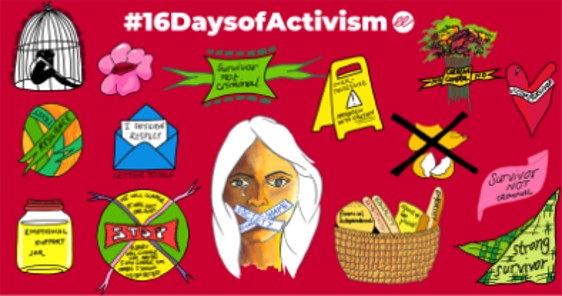
Artwork and communications - 16 days of activism 2025 - UNiTE to end digital violence against all women and girls
As part of the 16 Days of Activism to end Gender-based Violence, Engender Equality launched an online campaign presenting artwork which raised awareness of the impacts of digital abuse and the urgent need for accountability and change.
Thank you to our incredible volunteer, Akhila Shaha for collaborating with us to channel her art into a powerful awareness raising tool.