

Paper - Survivor feminism: Grace Tame's rhetoric of resistance, solidarity and transformation
By Christine Robertson
Masters of Arts (Writing) Research Project
University of New England
Media Release - New research shows Tasmanian systems enable abusive practices
MEDIA RELEASE
30 September 2025
NEW RESEARCH SHOWS TASMANIAN SYSTEMS ENABLE ABUSIVE PRACTICES
New research launched today by a Tasmanian specialist family violence service, Engender Equality, has found at least one form of systems abuse has been experienced by 75% of those engaging in family violence counselling.
The report launched today – Systems abuse and family violence in Tasmania: Evidence and recommendations for action – proposes a framework for deeper understanding of the ways systems themselves enable or enact abusive practices that negatively impact on victim-survivors.
Engender Equality CEO, Alina Thomas said,
“No one would agree that being re-traumatised by systems that are meant to serve the public, including victim-survivors is acceptable, yet on average, each victim-survivor experiences 3.44 incidents of organisational systems abuse.”
“Half of all victim-survivors experienced systems abuse in relation to Tasmania Police (50%) and family law proceedings in Tasmania (49%).
“Our analysis shows that systems abuse is also regularly experienced by victim-survivors across non-legal service systems,” Ms Thomas said.
Victims-survivors experienced system abuse through public and private housing (27%), primary care providers (19%), child safety (16%), mental health providers (12%), church or religious groups (9%), and education providers (8%).
Traditionally, systems abuse is generally defined by focusing on the perpetrator’s manipulation of systems, such as the legal system, to exert control over, threaten, and/or harass a current or former partner. Perpetrators might, for example, use systems to deplete the victim’s finances, emotional wellbeing and affect her capacity to care for children or work.
Organisational systems abuse, including people in power in these organisations, replicates the abuse of power and discrimination against victim-survivors. It is reflected in practices and attitudes that are discriminatory based on gender, financial impost, administrative requirements, time and mental load and emotional wellbeing.
Engender Equality Peer Worker, Ms Whaling said,
“I have been told in the court room, by financial institutions, and in prison, that the abuse did not happen. That I was an instigator. Those words came from people who were supposed to help… who knew what the perpetrator did to me, and how deeply it impacted me and my child.”
Lived experience coordinator, Sneha Sapkota explains,
“When a woman seeks help, she brings with her the trauma of abuse and the hope of being heard.
“The systems she encounters, through design, culture, and policies, either opens a door or builds another wall.
“Whether that space becomes protective or punishing depends on the service provider/practitioner’s ability to see beyond the surface and respond with both skill and humanity.
“These are structural and organisational processes and cultural attitudes that fail to recognise and respond to family violence, putting barriers in place instead; consequently enabling the views, values and beliefs of the perpetrator”, Ms Sapkota said.
The report’s recommendations are intended to identify and redress the organisational systemic elements that enable and enact systems abuse, in line with the Tasmanian Government’s Survivors at the centre: Tasmania’s Third Family and Sexual Violence Action Plan 2022-2027.
Ends.
Additional Information
A copy of the report can be obtained at Systems abuse and family violence in Tasmania: Evidence and recommendations for action, August 2025 – Engender Equality
Media opportunities will follow the launch that will be held:
Date: Tuesday, 30 Sept 2025
Time: 3:30pm – 4:30pm
Location: Mayor’s Suite, Town Hall
If you would like to engage a lived experience representative (case study), please see Advocates for Change – Engender Equality, email advocates@engenderequality.org.au or phone: 0415 740 524.
Media Contact: Alina Thomas 0438 788 291
Please find below – short overviews offered by Lived Experience Advocates on experiences of how systems have replicated power and control dynamics and how systems themselves are experienced as abusive by victim-survivors. Each of these people are available to talk to the media.
Deb H
“My ex exploited the social security system, and his employer colluded with him. My Sole Parent Benefit was being docked, as incentive for chasing up child support. I was being docked, the amount he should have been paying in child support, deducted from his wage, even though he was not paying anything. Once he was forced to start paying, he had to pay arrears but not having rent assistance, my situation was very dire, as I was paying mortgage, therefore, my social security payment was much less than for a sole parent renting. I struggled. I had to go to legal aid and get solicitor onto it before he started paying.”
Chantel
“Centrelink - When you move from a partnered to single parent, Centrelink asks for a lot of evidence, for e.g., third party statements. If a victim-survivor has no friends or people willing to be contacted, they cannot supply this statement. It becomes one more bureaucratic hurdle to jump when you are in crisis.
Child Support - Makes a victim-survivor stay connected to the abuser. Even when the abuser doesn’t pay, they can get away with it.
GP - I was forced to use the same GP as my perpetrator and was not allowed to see female doctors.
Loans/Payments - I split a loan to buy a car. My perpetrator only put his name on the car, but on the loan agreement had both of our names. I have to pay the loan back because I would get blacklisted otherwise.”
Bec
“The Child Support System is facilitation of abuse. In my case, my daughter has been withheld against me. He benefits financially. There was an issue and tax benefits occurred as debt in child support. My tax return was withheld from me and given to my ex. The child support worker advised to stop working as it’s the only way to stop the abuse.
I never received child support from him all the years as he would say if I went through with it, i would get no help and I can just get $30 a month as he was on Centrelink.”
Tracey
“Child Support - stated he made 10k while taking 3 overseas holidays.
Centrelink - payments affected due to how much he SHOULD pay.
And the fact that so much child support was owed, it effected my borrowing capacity with banks.”

Publication - Systems abuse and family violence in Tasmania: Evidence and recommendations for action, August 2025
This report aims to contribute to a better understanding of the systems abuse experienced by Tasmanian victim-survivors of family violence.
Systems abuse has long been recognised in Australia as a form of family violence, often experienced in the post-separation context. In this report we provide preliminary insights into the extent and complexity of these often opaque practices which are commonly faced by victim-survivors. It highlights the need for a more in-depth and extensive study of systems abuse in this State.

Publication - Comprehensive Support and Reflective Practice Model for AHS
The Comprehensive Support and Reflective Practice Model is for Aboriginal Health Service (AHS) workers and the Primary Care Family and Sexual Violence (PCFSV) Support Service to support people who are experiencing, or at risk, of family and/or sexual violence.
Service Agreement between the PCFSV Support Service and Aboriginal Health Services (AHS)
The Primary Care Family and Sexual Violence (PCFSV) Support Service partners with Aboriginal Health Service (AHS) workers to provide reflective practice, shared resources and collaborative approaches to supporting people experiencing, or at risk of, family and sexual violence (FSV).
A Template to create a Service Agreement between the PCFSV Support Service and Aboriginal Health Services (AHS) is available below.
Form - Consent to share information
The Primary Care Family and Sexual Violence (PCFSV) Support Service partners with Aboriginal Health Service (AHS) workers to provide reflective practice, shared resources and collaborative approaches to supporting people experiencing, or at risk of, family and sexual violence (FSV).
The personal details of the person being supported should be de-identified unless consent has been given and a signed Consent to Share Information Form has been shared with the PCFSV Support Specialist. The form is available below.
Comprehensive support Template
The Primary Care Family and Sexual Violence (PCFSV) Support Service partners with Aboriginal Health Service (AHS) workers to provide reflective practice, shared resources and collaborative approaches to supporting people experiencing, or at risk of, family and sexual violence (FSV).
An AHS worker may wish to use the Comprehensive support Template to assist the collaborative work centred around the safety of the person being supported and their children. The Template is available below.
Media Release - Coercion and control that limits reproductive autonomy in the spotlight
MEDIA RELEASE
22 September 2025
COERCION AND CONTROL THAT LIMITS REPRODUCTIVE AUTONOMY IN THE SPOTLIGHT
On World Contraception Day on 26 September 2025 Engender Equality wants to raise awareness of reproductive coercion, a behaviour that interferes with a person’s reproductive autonomy and is both a form of interpersonal abuse and sexual violence.
Engender Equality CEO, Alina Thomas said,
“These behaviours are usually perpetrated against women by male partners and almost always manifest within a broader pattern of controlling behaviours known as ‘coercive control’.
“Reproductive coercion can be hard to identify because it occurs privately, in a climate of controlling relationships, and involves significant feelings of shame for the victim.
“Traditional gender roles also reinforce men’s propriety over women, remembering that rape within marriage was legal in Australia until the late 1970s.
“Governmental policies and systems that influence or restrict reproductive choices, including those which limit access to termination, create a climate where reproductive coercion can flourish.
“Laws and regulations that interfere with an individual’s reproductive health decision-making cause psychological distress and create real barriers to a victim seeking help.
“Our Primary Care Family and Sexual Violence (PCFSV) Support Service is working with general practitioners throughout Tasmania to support their work with victim-survivors.
“We ask that they treat reproductive coercion with the same gravity and sensitivity you would other forms of intimate partner, sexual or family violence,” Ms Thomas said.
Reproductive coercion can include forcing or pressuring someone to become pregnant or to terminate a pregnancy or preventing someone from accessing contraception. Doing things to stop contraception from working such as ‘stealthing’, the act of removing a condom during sex, or forcing or pressuring someone to undergo sterilisation are also prevalent. Some perpetrators prevent their partners from accessing reproductive healthcare, including screening tests for sexually transmitted infections and cervical cancer (pap smears).
Reproductive nurse, working in primary care, Teagan Atkins, explains;
“If a patient appears intimidated by or afraid of their partner, the patient’s partner speaks for the patient, makes decisions on their behalf or is otherwise controlling, this would be a red flag.
“The patient’s partner may insist on attending routine medical appointments, including consultations on contraception and reproductive health to exert control.
“A patient appearing isolated from other family members and friends or who seems reluctant or regretful about their reproductive health choices, including past pregnancies or terminations may also indicate reproductive coercion,” Ms Atkins said.
Additional Information
This Primary Care Family and Sexual Violence Support Service is funded by Primary Health Tasmania (Tasmania PHN), through the Australian Government’s Primary Health Networks Program. Engender Equality is a not-for-profit agency leading the program in partnership with Laurel House.
More information can be obtained at https://engenderequality.org.au. More information including how General Practices and Aboriginal Health Services can connect with the service is available at 03 6268 1663, admin@pcfsv.org.au or www.engenderequality.org.au/pcfsv.
If you would like to engage a lived experience representative (case study), please see Advocates for Change – Engender Equality, email advocates@engenderequality.org.au or 0415 740 524.
Ends.
Media Contact: Alina Thomas 0438 788 291
Publication - Reproductive coercion - General Practice resource
Reproductive coercion is both a form of interpersonal abuse and a form of sexual violence. It is usually perpetrated against women by male partners and almost always manifests within a broader pattern of controlling behaviours known as ‘coercive control’.
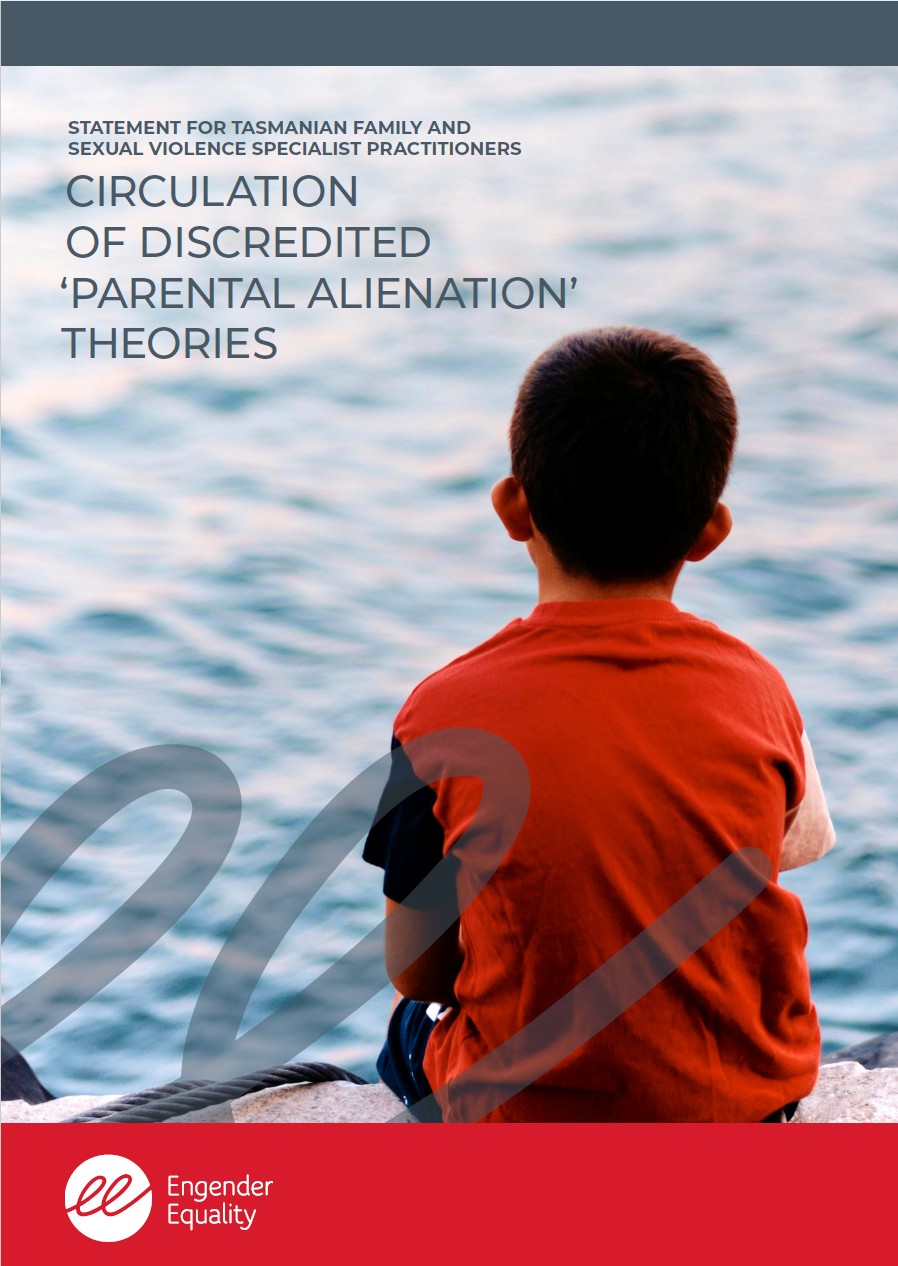
Statement for Tasmanian Family and Sexual Violence Specialist Practitioners - Circulation of discredited 'parental alienation' theories
There are ongoing reports of the discredited theory of ‘Parental Alienation’ (‘PA’) (also referred to as ‘Parental Alienation Behaviours’ or ‘Parental Alienation Syndrome’) being promoted online within certain practices and institutions. PA is widely criticised in Australia and overseas for its methodological weakness, lack of empirical foundation and weaponisation by people who use violence.
Practitioners are encouraged to monitor and counter the promotion of PA using the information provided in the Statement below and request further information from Engender Equality if required.