


Media Release - Coercion and control that limits reproductive autonomy in the spotlight
MEDIA RELEASE
22 September 2025
COERCION AND CONTROL THAT LIMITS REPRODUCTIVE AUTONOMY IN THE SPOTLIGHT
On World Contraception Day on 26 September 2025 Engender Equality wants to raise awareness of reproductive coercion, a behaviour that interferes with a person’s reproductive autonomy and is both a form of interpersonal abuse and sexual violence.
Engender Equality CEO, Alina Thomas said,
“These behaviours are usually perpetrated against women by male partners and almost always manifest within a broader pattern of controlling behaviours known as ‘coercive control’.
“Reproductive coercion can be hard to identify because it occurs privately, in a climate of controlling relationships, and involves significant feelings of shame for the victim.
“Traditional gender roles also reinforce men’s propriety over women, remembering that rape within marriage was legal in Australia until the late 1970s.
“Governmental policies and systems that influence or restrict reproductive choices, including those which limit access to termination, create a climate where reproductive coercion can flourish.
“Laws and regulations that interfere with an individual’s reproductive health decision-making cause psychological distress and create real barriers to a victim seeking help.
“Our Primary Care Family and Sexual Violence (PCFSV) Support Service is working with general practitioners throughout Tasmania to support their work with victim-survivors.
“We ask that they treat reproductive coercion with the same gravity and sensitivity you would other forms of intimate partner, sexual or family violence,” Ms Thomas said.
Reproductive coercion can include forcing or pressuring someone to become pregnant or to terminate a pregnancy or preventing someone from accessing contraception. Doing things to stop contraception from working such as ‘stealthing’, the act of removing a condom during sex, or forcing or pressuring someone to undergo sterilisation are also prevalent. Some perpetrators prevent their partners from accessing reproductive healthcare, including screening tests for sexually transmitted infections and cervical cancer (pap smears).
Reproductive nurse, working in primary care, Teagan Atkins, explains;
“If a patient appears intimidated by or afraid of their partner, the patient’s partner speaks for the patient, makes decisions on their behalf or is otherwise controlling, this would be a red flag.
“The patient’s partner may insist on attending routine medical appointments, including consultations on contraception and reproductive health to exert control.
“A patient appearing isolated from other family members and friends or who seems reluctant or regretful about their reproductive health choices, including past pregnancies or terminations may also indicate reproductive coercion,” Ms Atkins said.
Additional Information
This Primary Care Family and Sexual Violence Support Service is funded by Primary Health Tasmania (Tasmania PHN), through the Australian Government’s Primary Health Networks Program. Engender Equality is a not-for-profit agency leading the program in partnership with Laurel House.
More information can be obtained at https://engenderequality.org.au. More information including how General Practices and Aboriginal Health Services can connect with the service is available at 03 6268 1663, admin@pcfsv.org.au or www.engenderequality.org.au/pcfsv.
If you would like to engage a lived experience representative (case study), please see Advocates for Change – Engender Equality, email advocates@engenderequality.org.au or 0415 740 524.
Ends.
Media Contact: Alina Thomas 0438 788 291

Publication - Reproductive coercion - General Practice resource
Reproductive coercion is both a form of interpersonal abuse and a form of sexual violence. It is usually perpetrated against women by male partners and almost always manifests within a broader pattern of controlling behaviours known as ‘coercive control’.
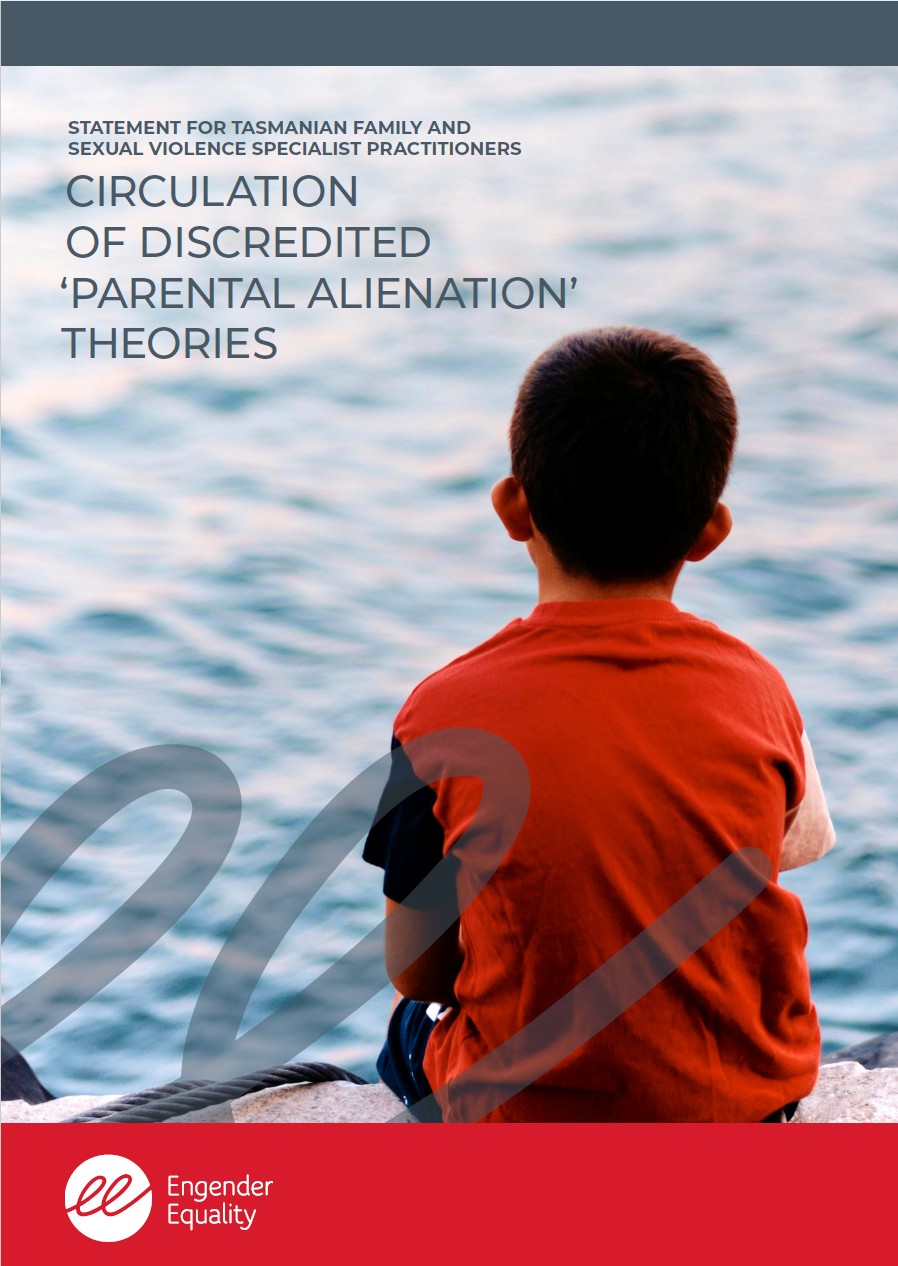
Statement for Tasmanian Family and Sexual Violence Specialist Practitioners - Circulation of discredited 'parental alienation' theories
There are ongoing reports of the discredited theory of ‘Parental Alienation’ (‘PA’) (also referred to as ‘Parental Alienation Behaviours’ or ‘Parental Alienation Syndrome’) being promoted online within certain practices and institutions. PA is widely criticised in Australia and overseas for its methodological weakness, lack of empirical foundation and weaponisation by people who use violence.
Practitioners are encouraged to monitor and counter the promotion of PA using the information provided in the Statement below and request further information from Engender Equality if required.
Engender Equality Strategic Plan 2024-2027
Welcome to Engender Equality’s Strategic Plan 2024-2027 including our key priorities for 2024-2026

Paper Trail - A poem
Paper Trail
She is nothing,
but she has a point of view.
She is young,
but she rummages through
the tissues in her bra,
she’s no star.
She has no pockets
for ritzy spent dockets;
she is just nothing,
but she has a point of view.
He’s not the right image,
for you, true blue.
You’re tiptoeing around
with only one shoe.
He’s not the right image
for us too.
The female beast
is the one inside you.
Censoring self,
isn’t your due.
There’s blue paint
on the ceiling,
as a short-film mart.
Plastered on the wall
peeling off your heart,
is just the start.
The hostage burns slow
when the light gets too low.
Self-sabotage protects the other,
self-delete inserts another.
Anon.

Newsletter - Support for General Practices to support victim-survivors - Engender Equality Update - September 2025
Supporting general practices and Aboriginal health services in responding to family violence, sexual violence and child sexual abuse through the PCFSV Pilot program.

News item - New program training GPs in responding to domestic and family violence in Tasmania
By Meg Whitfield
Posted to ABC News, 07/09/25 – 8:07am
Roughly 1 in 5 women make their first disclosure of family violence to their doctor, but a lack of confidence in knowing how to best respond can hold GPs back from coordinating support services.
A pilot project in Tasmania is helping GPs and medical practices better recognise signs of domestic and family violence.
Publication - Trauma-informed primary care response to sexual assault and intimate partner violence
When a patient presents following sexual assault – particularly in the context of intimate partner violence (IPV) – the health response must prioritise safety, dignity, and autonomy above all else. Victim-survivors of IPV often live under coercion, fear, and threats of retribution, and disclosures regarding sexual health can be weaponised by abusive partners.
Media Release - Sexual justice exists with free and healthy decisions for victim-survivors of violence
MEDIA RELEASE
2 September 2025
SEXUAL JUSTICE EXISTS WITH FREE AND HEALTHY DECISIONS FOR VICTIM-SURVIVORS OF VIOLENCE
Engender Equality is using World Sexual Health Day 2025 on 4 September 2025 to remind Tasmanians that sexual health can only truly exist when people can live without discrimination, fear, shame, and stigma.
Sexual assault is an insidious and violent violation and is also a health issue for many victim-survivors. Sexual health care after assault means communicating with care and making sure victim-survivors feel believed, supported, and afforded every safeguard for their health and recovery.
Engender Equality CEO, Alina Thomas says,
“The reality is that sexual assault within intimate partner relationships carries particular and heightened risks.
“Sexual assault creates health risks and fears including the possibility of sexually transmissible infections (STIs), unwanted pregnancies, and trauma.
“When victim-survivors disclose sexual assault, their safety, dignity, wellbeing and their autonomy must be at the centre for treating General Practitioners and other frontline professionals.
“The conversations that follow—about sexual health, transmittable infections, and safe follow-up—can be especially delicate.
“Shame, coercion, and fear of retribution often stop victim-survivors from being able to manage the full scope of the risks and consequences of their situation. They may be in the very high risk position of having to talk to their abusive partner about their sexual health and this can expose them to escalations of violence and abuse.
“While it may feel important to rush towards screening for sexually transmitted infections, this response must be delivered by practitioners informed about signs and symptoms of infection, and the fact that many STIs are asymptomatic—so is not necessarily the most urgent task when an assault has been reported.
“Every step of this process needs to be explained in simple, supportive terms that restore agency and reduce shame.
“This is where our Primary Care Family and Sexual Violence program is essential in providing support to General Practices with specialist knowledge and skills to navigate this complexity,” Ms Thomas said.
Jess Drew is the Manager of the Primary Care Family and Sexual Violence Pilot, funded by Primary Health Tasmania. Ms Drew explains,
“While in most cases, the risk of an STI transmission is no higher than any other sexual exposure, the fear itself is real and requires careful management.
“We test at baseline to rule out pre-existing infections, but most infections won’t show up until 14 days or more later.
“That’s why clear information, follow-up testing, and supportive care are so important; building trust through listening to and validating the patient is critical,” Ms Drew reported.
Additional Information
This Primary Care Family and Sexual Violence support initiative is funded by Primary Health Tasmania (Tasmania PHN), through the Australian Government’s Primary Health Networks Program. Engender Equality is a not-for-profit agency leading the program in partnership with Laurel House.
More information including how General Practices and Aboriginal Health Services can connect with the service is available at 03 6268 1663, admin@pcfsv.org.au or www.engenderequality.org.au/pcfsv.
If you would like to engage a lived experience representative (case study), please see Advocates for Change – Engender Equality , email advocates@engenderequality.org.au or 0415 740 524.
Media Contact: Alina Thomas 0438 788 291
Media Release - Tasmania leads Australia with innovative guidelines to inform doctors on LGBTIQA+ family violence response
MEDIA RELEASE
27 August 2025
TASMANIA LEADS AUSTRALIA WITH INNOVATIVE GUIDELINES TO INFORM DOCTORS ON LGBTIQA+ FAMILY VIOLENCE RESPONSE
As we approach ‘Wear Purple Day’ on 29 August, two projects delivered by Engender Equality are merging in Tasmania to address LGBTIQA+ issues of intimate partner violence (IPV).
Engender Equality recently lead Australia in delivering guidelines to fill the gap where there were no dedicated family violence services or tailored resources specifically for LGBTIQA+ people in Tasmania.
Now the guidelines, distributed Australia-wide, will be offered to general practices, to guide inclusive and affirmative practice. This is being delivered through the recently launched Primary Care Family and Sexual Violence project which is offering support and resources to build capacity among 140 general practices in Tasmania.
Engender Equality CEO, Alina Thomas said,
“General practices are the frontline and perfect point for early intervention for anyone who is subject to intimate partner violence.
“Sadly, many LGBTIQA+ people try to navigate services without knowing whether providers had the skills or understanding to meet their needs. All too often they chose not to access services at all.
“By addressing the unique challenges faced by LGBTIQA+ individuals, we can work towards reducing the prevalence of IPV and improve outcomes for survivors.
“Apart from societal stigma discouraging folks from seeking help, there is fear of discrimination by law enforcement and support services, and insufficient laws protecting LGBTQA+ individuals from violence and discrimination, making it difficult for survivors to find legal recourse,” Ms Thomas said.
Intimate partner violence (IPV) affects LGBTIQA+ individuals at rates comparable to or higher than those in heterosexual relationships, with unique challenges and barriers to seeking help.
Research indicates that the lifetime prevalence of intimate partner violence among LGBTIQA+ individuals is significant. For instance, studies show that bisexual women experience IPV at rates of 69%, while gay men and bisexual men also face high rates of IPV, with 47% and 46%, respectively. These figures are often comparable to or exceed those of heterosexual individuals.
This Primary Care Family and Sexual Violence is supported by funding from Primary Health Tasmania (Tasmania PHN) through the Australian Government’s Primary Health Networks Program. Engender Equality is a not-for-profit agency leading the program in partnership with Laurel House and Sexual Assault Support Service (SASS).
More information including how General Practices and Aboriginal Health Services can connect with the service is available at 03 6268 1663, admin@pcfsv.org.au or www.engenderequality.org.au/pcfsv.
Ends.
Media Contact: Alina Thomas 0438 788 291