
Media Release - Safe landing required as violence rises significantly over the holiday period
MEDIA RELEASE
17 December 2025
SAFE LANDING REQUIRED AS VIOLENCE RISES SIGNIFICANTLY OVER THE HOLIDAY PERIOD
Tasmanian family violence service, Engender Equality is calling for awareness and empathy from service providers over the Christmas holiday period when Australian crime statistics and police data show a significant rise in family and sexual violence incidents.
Engender Equality CEO, Alina Thomas said,
“It can be a very challenging time for victim-survivors as perpetrator’s use Christmas
‘arrangements’, particularly in relation to children, to manipulate and attempt to exert control over, threaten, and/or harass a current or former partner.
“Safe spaces such as work and school are closed, as are services that facilitate safe changeovers for parents who are experiencing post-separation abuse.
“We ask that when victim-survivors reach out for help from those services there to support them — such as Police, Accident and Emergency, GPs and the courts -they feel believed, supported and protected.
“The practices and attitudes of the support systems can make an enormous difference to the safety of victim-survivors and their children.
The following Family and sexual violence support services may also be available:
| Family and sexual violence support services | ||
| Service | Contact | Hours |
| Emergency | 000 | 24/7 |
| FVCSS (Family Violence Counselling Support Service) | 1800 608 122
|
9am – midnight weekdays
4pm – midnight weekends and public holidays |
| (03) 6777 2290 South | ||
| (03) 6166 0444 North-West | ||
| Strong Families, Safe Kids | Free Call 1800 000 123 | |
| Lifeline | 13 11 14
Text 0477 13 11 14 |
24/7 |
| SASS | 1800 697 877 | 24/7 |
| Laurel House | 1800 697 877
1800 MYSUPPORT |
24/7 |
| Northern Tasmania
(03) 6334 2740 |
||
| Northwest Tasmania
(03) 6431 9711 |
||
| Safe Choices | 1800 806 189 | 9am and 5pm – Monday to Friday |
| Text 0448 046 918 (South) | ||
| Text 0439 910 435 North & Northwest | ||
| safechoices@aohtas.org.au | ||
| 1800 RESPECT national helpline | 1800 737 732 | 24/7 |
| Text (SMS) ‘HELLO’ or a greeting to 0458 737 732 | 24/7 | |
| Men’s Referral Service | 1300 766 491 | 24/7 |
For more information visit the Engender Equality website or phone (03) 6278 9090.
If you would like to engage a lived experience representative (case study), please see Advocates for Change – Engender Equality, email advocates@engenderequality.org.au or phone: 0415 740 524.
Ends.
Media Contact: Alina Thomas 0438 788 291

Newsletter - Lived experience expertise, victim-survivors who have been in prison - Engender Equality Update - December 2025
Engender Equality elevates lived experience of family violence and imprisonment as essential expertise for real system change.
We are proud to introduce three outstanding Advocates for Change graduates whose leadership and lived experience are shaping trauma-informed and accountable responses for victim-survivors. To engage lived experience expertise or representation, please get in touch.

Submission in relation to the Tasmanian Liquor Licensing Reforms, 12 December 2025
Engender Equality welcomes the opportunity to provide feedback on the Tasmanian Government’s proposed liquor licensing reforms. It is commendable that the consultation paper has stated the Government’s intention to adopt a “risk-based approach to managing the harms from liquor” and to consider alcohol’s role in family and domestic violence. In order to do this, Engender Equality advocates
for a well-informed analysis of the role of alcohol in reinforcing behaviours and systems that condone violence against women.
Media Release - Bushfire season sends more than the bush up in flames
MEDIA RELEASE
8 December 2025
BUSHFIRE SEASON SENDS MORE THAN THE BUSH UP IN FLAMES
Tasmanian family violence service, Engender Equality is reminding the Tasmanian community that outdated and harmful gendered expectations of both men and women during disasters increases the risk of family violence.
Engender Equality CEO, Alina Thomas said,
“Violence against women has been found to increase during and after disasters.
“Traditional gender roles place expectations on men to provide and protect, and on women to nurture and care for others, sometimes at the expense of their own safety and wellbeing.
“This contributes to increased violence against women and their children and negative consequences for women, men and LGBTQIA+ people, long after the fire front has moved through.
“Excuses are made for men’s violence because they may have suffered in the disaster, or because they are seen as ‘good blokes’ and even ‘heroic’.
“This condoning of men’s violence against women and their children is extremely damaging for disaster survivors.
“We all have a role to play in disaster planning, response and recovery — including paying attention to the health of our relationships, not just the safety of people and property.” Ms Thomas said.
Australian research1 has indicated that domestic violence increased following the 2009 bushfires, and, further, that women’s voices were effectively silenced (Parkinson, 2012). After the Black Saturday bushfires, men, women, and emergency workers all spoke of male behaviours following the traumatic experience of the fires and in their aftermath, that were harmful both to themselves and to those close to them (Parkinson, 2012; Zara & Parkinson, 2013).
For more information visit the Engender Equality website or phone (03) 6278 9090.
Ends.
Media Contact: Alina Thomas 0438 788 291
ADDITIONAL INFORMATION
If you would like to engage a lived experience representative (case study), please see Advocates for Change – Engender Equality, email advocates@engenderequality.org.au or phone: 0415 740 524.
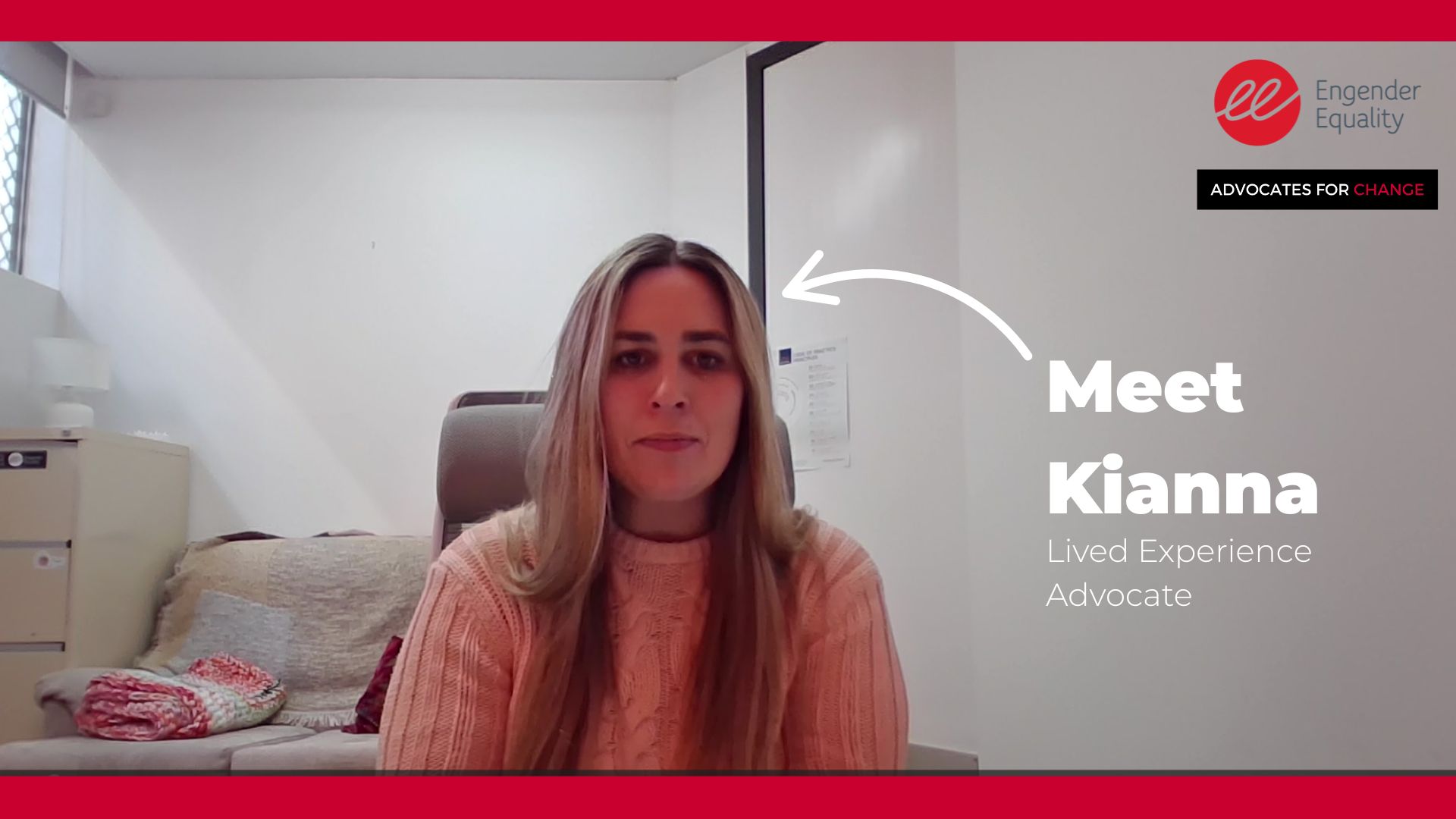
Video - Advocates for Change - Meet Kianna
Like many women in Australia, Kianna has experienced family violence and sexual assault. She has also been to prison.
Kianna has joined the Advocates for Change program because she believes that women who have survived violence do have a voice. She believes that they can come together and create change for all victim-survivors.
Kianna is doing a series of videos to answer some of the thoughts and concerns you may have before joining us in advocacy.
You are not alone. Your experiences matter. You have the right to feel safe, to be supported.
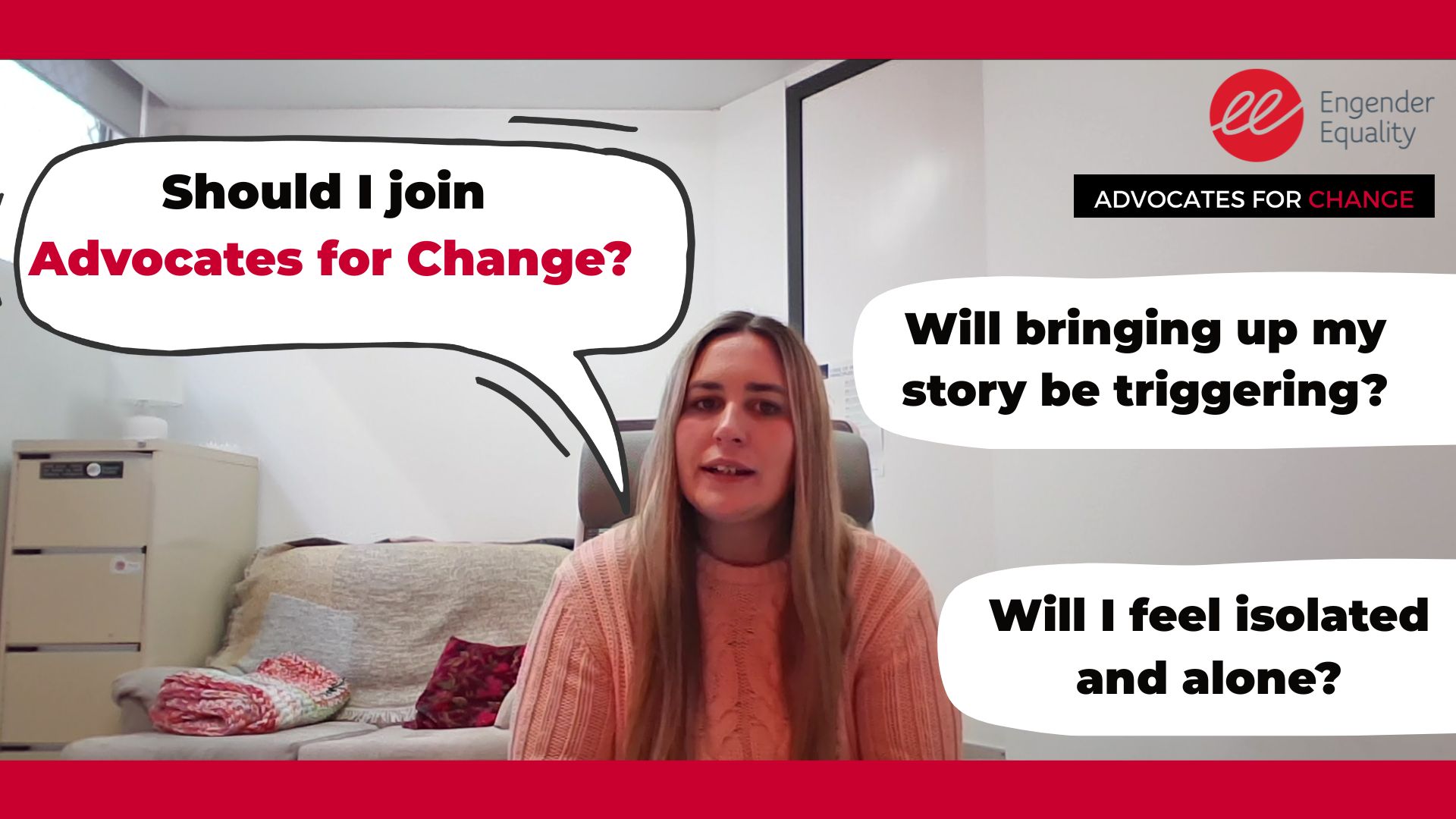
Video - Will bringing up my story be triggering?
If you are a victim-survivor of family violence and have been to prison, our advocacy program is for you!
We understand that you may have some questions or concerns about becoming an advocate. You are not alone.
In this video, Kianna explores her first question – Will brining up her story be triggering/ Will she feel alone and isolated?
Video - How much of my story will I have to share?
If you are a victim-survivor of family violence and have been to prison, our advocacy program is for you!
We understand that you may have some questions or concerns about becoming an advocate. You are not alone.
In this video, Kianna talks about how much you will have to share as an advocate to end gender-based violence.
Video - What about confidentiality and privacy?
If you are a victim-survivor of family violence and have been to prison, our advocacy program is for you!
We understand that you may have some questions or concerns about becoming an advocate. You are not alone.
In this video, Kianna talks about how you have the choice to reveal or conceal your identity. We are guided by you.
Video - What if sharing my story pulls me back into a life I've left behind?
If you are a victim-survivor of family violence and have been to prison, our advocacy program is for you!
We understand that you may have some questions or concerns about becoming an advocate. You are not alone.
In this video, Kianna addresses a concern she has had, “What if sharing my story with the world leads me back to a lifestyle I have overcome such as going back to prison or active addiction?”
Video - What if I am blamed, judged or criticised?
If you are a victim-survivor of family violence and have been to prison, our advocacy program is for you!
We understand that you may have some questions or concerns about becoming an advocate. You are not alone.
In this video, Kianna talks about her concerns around being blamed for the abuse she endured, and being judged and criticised for speaking up.